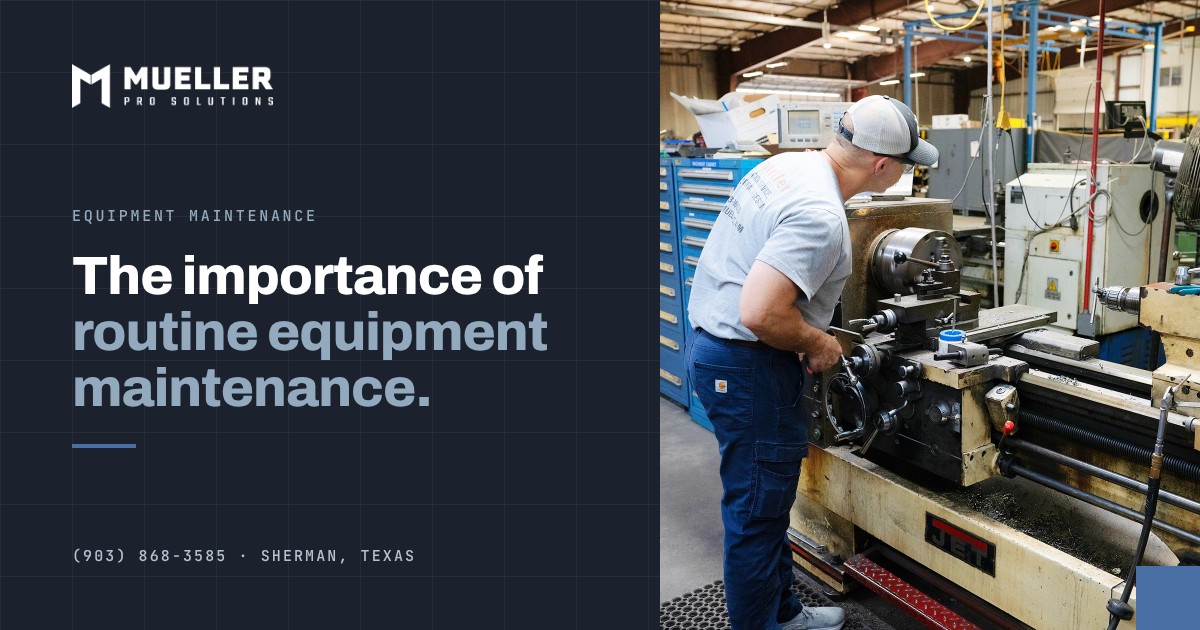
The importance of routine equipment maintenance comes down to one thing: it's cheaper and safer to fix small problems on your schedule than big ones on the machine's schedule. This guide covers the real costs of downtime, how often to maintain equipment and how Sherman, TX plants can build a maintenance plan that sticks.
The short answer: Routine equipment maintenance is important because it prevents unplanned breakdowns, lowers repair and maintenance costs, extends equipment life and keeps workers safer. U.S. Department of Energy guidance estimates preventive maintenance can save 12% to 18% compared with a run-to-failure approach.
Key Takeaways
- Downtime costs more than maintenance. Siemens estimates unplanned downtime costs the world's 500 largest companies $1.4 trillion a year.
- Most plants are still too reactive. DOE guidance found more than 55% of maintenance at an average facility is reactive.
- The right schedule is equipment-specific. Start with the manufacturer's recommendations, then adjust based on your run hours and failure history.
Why Is Routine Equipment Maintenance Important?
Think of maintenance like changing the oil in your truck. Skipping it saves a few minutes today and costs you an engine later.
Industrial equipment works the same way, except the "engine" might be a production line and the cost includes every hour it isn't running.
The benefits of equipment maintenance
- Fewer surprise breakdowns. Worn bearings, loose belts and failing seals get caught before they fail.
- Lower costs. Planned repairs are cheaper than emergency repairs and lost production.
- Longer equipment life. Well-maintained machines last longer before they need major rebuilds or replacement.
- Safer work. Equipment that behaves predictably is safer to run and service.
- Better product quality. Machines in spec make parts and product in spec.
Try this: Pull your last 12 months of repair tickets. Circle every repair that was an emergency. That's your starting list for preventive maintenance.
How Much Does Unplanned Downtime Really Cost?
More than most people guess. Siemens' 2024 True Cost of Downtime report found that unplanned downtime costs the Fortune Global 500 an estimated $1.4 trillion a year, about 11% of their revenues.
The same report found:
| Measure | Siemens 2024 estimate |
|---|---|
| Unplanned downtime at a large plant | 27 hours a month, on average |
| Cost of one hour of downtime, large automotive plant | About $2.3 million |
| Cost of one hour of downtime, low end of consumer goods | About $36,000 |
Your plant may be smaller than those, but the math works the same way. Add up lost production, idle labor, overtime, rush shipping on parts and late orders, and an hour of downtime adds up fast.
Tip: Estimate your own cost per hour of downtime. Even a rough number makes it much easier to justify a maintenance budget to leadership.
How Does Preventive Maintenance Reduce Maintenance Costs?
The U.S. Department of Energy's Federal Energy Management Program (FEMP) compared maintenance strategies in its O&M Best Practices Guide. Its findings are still a useful benchmark:
| Strategy | How it works | Estimated savings (DOE/FEMP) |
|---|---|---|
| Reactive | Fix equipment after it breaks | Baseline |
| Preventive | Service equipment on a set schedule | "As much as 12% to 18% on the average" vs. reactive |
| Predictive | Service based on data like vibration or temperature trends | Another 8% to 12% over a preventive program |
Yet "more than 55% of maintenance resources and activities of an average facility are still reactive." In plain terms, most facilities are still waiting for things to break, and paying for it.
Try this: You don't have to overhaul everything at once. Move your three most critical machines to a preventive schedule first, then expand.
How Often Should Industrial Equipment Be Maintained?
There's no one-size-fits-all schedule for industrial equipment maintenance. The right interval depends on the machine, how hard it runs and the environment it runs in. A good starting framework:
| Interval | What to check |
|---|---|
| Daily | Operator checks for leaks, unusual noise, vibration, heat and guard condition |
| Weekly | Lubrication, belt and chain tension, filter checks |
| Monthly or quarterly | Alignment checks, wear part inspection, electrical connections |
| Annually | Major inspections, rebuilds of high-wear components and a review of the plan itself |
Start with the manufacturer's recommended intervals. Then adjust based on run hours, your failure history and conditions like heat, dust or washdowns.
Tip: If you service equipment, OSHA also requires lockout/tagout procedures to be reviewed "at least annually." Fold that review into your yearly maintenance planning.
How Much Does Routine Equipment Maintenance Cost?
It depends on the type and number of machines, how often they need service and whether you use an in-house team, an outside provider or a mix. Because every plant is different, the best way to get a real number is a site walk and quote from a provider.
Compare it to the cost of not maintaining
A better question may be what it costs not to maintain your equipment. Compare a maintenance contract against:
- Your estimated cost per hour of downtime
- Emergency repair rates and rush parts
- Overtime to catch up on lost production
- Shortened equipment life and early replacement
Mueller Pro Solutions offers free consultations for most projects, and an engineer responds to inquiries within one business day.
What Should a Routine Maintenance Plan Include?
A plan doesn't have to be complicated. It just has to be written down and followed. Include:
- An equipment list ranked by how critical each machine is to production
- Service tasks and intervals for each machine
- Who's responsible for each task
- A spare and critical-parts list, so you're not waiting on a part during a breakdown
- A simple log of every service and repair
- A yearly review to adjust intervals based on what actually failed
Try this: Ask "What would stop our line for more than a day?" Make sure the parts for those failures are on your shelf or that you have a shop that can make them quickly.
How Do You Choose an Equipment Maintenance Company in Sherman, TX?
"Best" depends on your plant, but the strongest maintenance partners tend to have a few things in common. Look for a company that:
- Can make parts, not just order them. An in-house machine and fabrication shop means less waiting when a part fails or is no longer made.
- Responds around the clock. Breakdowns don't keep business hours.
- Knows your industry. Food and beverage, oil and gas and pharmaceutical plants each have their own sanitation, safety and uptime demands.
- Documents its work. Service records and failure reports help you spot patterns and adjust your plan.
- Helps you prevent the next failure. A good partner doesn't just fix the machine. They help you figure out why it broke.
Tip: Ask any provider to walk you through how they'd handle your most critical machine going down at 2 a.m. on a Saturday. Their answer will tell you a lot.
Who Offers Equipment Maintenance Services in Sherman, TX?
Mueller Pro Solutions, based at 5100 Marshall St. in Sherman, has served industrial customers since 1981. Its in-house machine shop, fabrication shop and field crews support:
- Ongoing preventive maintenance programs and maintenance contracts
- Spare and critical-part planning
- 24/7 emergency repair, with onsite welding and machining
- Replacement parts made in-house, including obsolete parts reverse engineered from a sample
When something does fail, Mueller documents the failure after restart and can set up a preventive maintenance plan so the same stoppage doesn't happen again. They serve food and beverage, oil and gas, pharmaceutical and general manufacturing plants across Texoma, North Texas, southern Oklahoma and nationwide.
The Bottom Line
The importance of routine equipment maintenance shows up on your bottom line. Scheduled maintenance costs less than downtime, catches problems early and keeps your crew safer. Start with your most critical machines, write the plan down and review it every year.
Want help building a maintenance plan? Call Mueller Pro Solutions at (903) 868-3585 or email info@muellerprosolutions.com.
Sources
- Siemens, The True Cost of Downtime 2024
- U.S. Department of Energy, FEMP / PNNL, O&M Best Practices: A Guide to Achieving Operational Efficiency, Release 2.0 (2004), Chapter 5
- OSHA, 29 CFR 1910.147
- Mueller Pro Solutions, Emergency Repair
- Mueller Pro Solutions, Precision Machining
- Mueller Pro Solutions, Home