
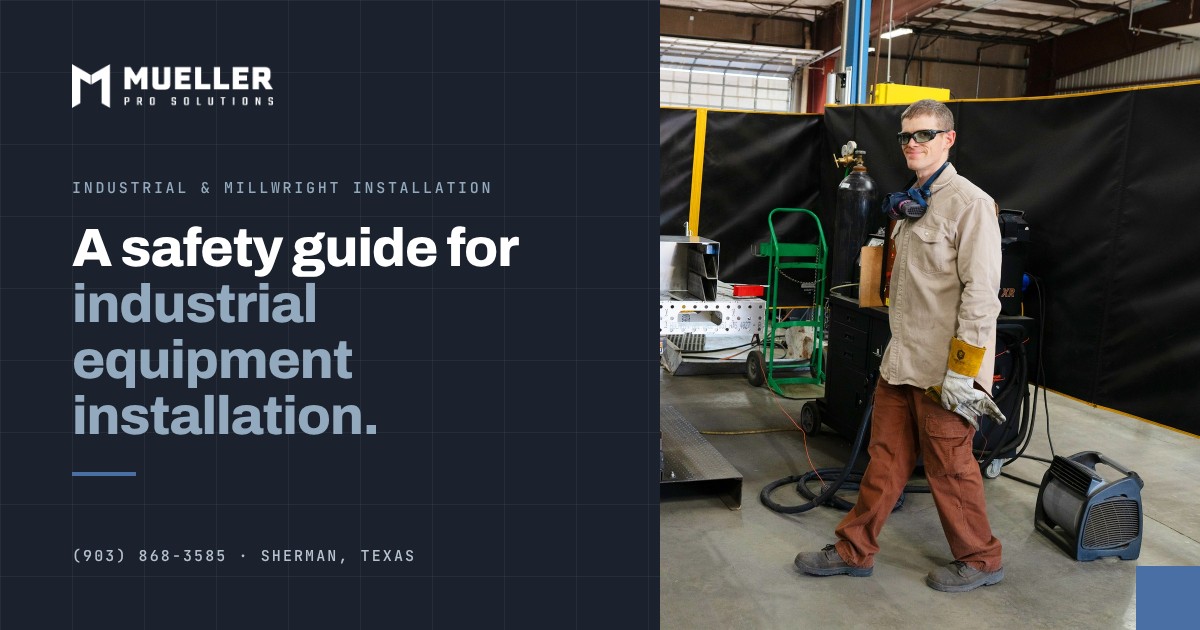
This guide walks Sherman, TX plant managers through every stage of a safe industrial equipment installation, from planning around your shutdown window to a controlled restart. You'll get a practical checklist, the OSHA rules that apply, permit pointers and tips for choosing an installation crew you can trust.
The short answer: To install industrial machinery safely, plan the work around your shutdown window, lock out every energy source, rig and set the equipment with trained millwrights, anchor and guard it, and restart it under controlled conditions with the installer on the floor. Skipping any of those steps is where most installation risk comes from.
Key Takeaways
- Planning is a safety step. Scheduling the install around your production calendar keeps crews from rushing.
- Lockout/tagout is non-negotiable. It's one of OSHA's most-cited standards year after year.
- The restart matters as much as the setup. A controlled first run catches problems before they hurt someone or ruin product.
Why Does Equipment Installation Need Its Own Safety Plan?
Picture a 10-ton machine hanging from rigging over a concrete floor while electricians, millwrights and your own maintenance staff all work around it. That's a normal installation day, and it's why "we'll figure it out on site" isn't a plan.
Installation combines several high-risk tasks at once:
- Heavy lifts
- Live energy sources nearby
- New equipment that nobody has run yet
- People who don't usually work together
OSHA notes that moving machine parts can cause injuries "such as crushed fingers or hands, amputations, burns, or blindness."
Try this: Before any install, write down every energy source within reach of the work area: electrical, pneumatic, hydraulic, steam, gravity and stored mechanical energy. That list becomes the backbone of your safety plan.
What Belongs on an Installation Safety Checklist?
A good checklist covers the full job, not just the lift. Use this as a starting point and adjust it for your plant.
Before the install
- Confirm the shutdown window and who has authority to stop work
- Review drawings, equipment weights and floor load limits
- Survey the site and measure clearances, doorways and travel paths
- Identify every energy source and write the lockout/tagout procedure
- Confirm rigging plans, lifting equipment and operator qualifications
- Check whether local permits or inspections apply (see below)
- Hold a pre-job safety briefing with every crew on site
During the install
- Apply locks and tags, then verify zero energy before work starts
- Keep the lift zone clear and use a spotter
- Set, level and align the equipment to spec
- Anchor fixed machinery to the floor or structure
- Install guards before anyone tests a moving part
After the install
- Walk down all connections: electrical, air, water and product lines
- Remove locks and tags only after everyone is accounted for
- Run a controlled restart with the installer present
- Train operators and update maintenance records
Tip: Print the checklist and have the crew lead sign off on each section. A signed checklist is also useful documentation if questions come up later.
How Does Lockout/Tagout Protect Your Crew?
Lockout/tagout (LOTO) is the process of shutting off and locking energy sources so equipment can't start up unexpectedly while people are working on it. OSHA's standard, 29 CFR 1910.147, "covers the servicing and maintenance of machines and equipment."
It's also one of the rules plants struggle with most. Two of the standards covered in this guide appear on OSHA's preliminary list of most frequently cited standards for fiscal year 2026:
| Standard | What it covers | FY2026 rank (preliminary) |
|---|---|---|
| Control of Hazardous Energy (lockout/tagout) | Keeping equipment from starting up during service or maintenance | No. 3 |
| Machine Guarding | Protecting workers from moving parts and point-of-operation hazards | No. 10 |
What the LOTO standard requires
Every plant should already have these in place:
- Written procedures. "Procedures shall be developed, documented and utilized for the control of potentially hazardous energy."
- Training. Employers must make sure "the purpose and function of the energy control program are understood."
- Annual review. Employers must inspect their energy control procedures "at least annually."
Try this: When an outside crew is installing equipment, agree in writing whose lockout procedure applies and how the two teams will coordinate locks. Mixed crews are where gaps happen.
How Do You Safely Rig, Set and Anchor Heavy Machinery?
Rigging is where an installation can go wrong fastest. The goal is simple: move the equipment without dropping it, tipping it or pinning anyone, then lock it in place so it never moves on its own.
A safe rigging and setting process usually includes:
- Confirming the equipment's weight and center of gravity
- Choosing rated slings, shackles and lifting equipment for that load
- Clearing and marking the travel path
- Setting the equipment on a level, prepared foundation
- Precision alignment so shafts, belts and conveyors line up
Once it's set, it needs to stay put. OSHA's machine-guarding rule says, "Machines designed for a fixed location shall be securely anchored to prevent walking or moving."
Why this is millwright work
As Mueller Pro Solutions puts it, millwrights "move, set, align, and connect industrial machinery." In Sherman, Mueller's crews handle installation, alignment, relocation, rigging and plant-wide process replacements.
Tip: Ask your installer what happens if a part doesn't fit once the machine is set. Mueller's crews fabricate transitions, supports and adapters on site, backed by their own machine and fabrication shop, so a mismatch doesn't stall the job or tempt anyone into a risky workaround.
Why Do Machine Guards Go On Before Testing?
It's tempting to "just bump it" to check rotation before the guards are on. That's exactly the moment someone's hand is in the wrong place.
OSHA requires that "one or more methods of machine guarding shall be provided to protect the operator and other employees." Guards cover hazards at:
- The point of operation
- Pinch points
- Moving parts
- Flying sparks or debris
Try this: Make "guards installed and checked" a hard stop on your checklist. No guard, no test run.
Do You Need a Permit to Install Equipment in Sherman, TX?
It depends on the scope of the project. Setting a machine on an existing floor may not need anything, while new electrical service, structural changes, gas lines or plumbing tie-ins often do. Because requirements vary by project, check with the City of Sherman's building and permitting office before work starts.
State rules for certain equipment
Some equipment also has state-level rules. For example, the Texas Department of Licensing and Regulation (TDLR) says a boiler "shall not be test-fired or operated until the required initial inspection has been completed and passed." TDLR also requires a Boiler Installation Report within 30 days of installation.
Tip: Ask your installer to help identify which permits and inspections apply. This isn't legal advice, so confirm final requirements with the city and any state agency involved.
How Long Does Industrial Equipment Installation Take?
There's no single answer. A single machine swap can take a shift, while relocating a full production line can take weeks. Timing depends on:
- The size and number of machines
- How much site prep and foundation work is needed
- Utility tie-ins and controls integration
- Whether parts can be prefabricated before the shutdown
- Permit and inspection timing
How to shorten your shutdown
The biggest time-saver is early planning. Mueller Pro Solutions recommends calling as soon as you know your shutdown window, because more lead time means more components can be prefabricated off-line. Their approach: "We plan the sequence around your shutdown window, not the other way around." Crews can also work nights and weekends when the window requires it.
What Does a Safe Restart Look Like?
The install isn't done when the bolts are tight. It's done when the equipment runs safely under real conditions.
A controlled restart typically means:
- Clearing all people and tools from the equipment
- Removing locks and tags in the right order
- Starting at low speed or without product first
- Watching for vibration, noise, heat and leaks
- Having the installer on the floor to make adjustments
Mueller Pro Solutions finishes each installation with final connections and checks, followed by a controlled restart with their staff on the floor.
Who Installs Industrial Equipment in Sherman, TX?
Mueller Pro Solutions has been engineering, building and installing equipment from Sherman since 1981 and is now in its third generation of family ownership. Their equipment installation services include:
- Turnkey equipment installation
- Millwright services and precision alignment
- Equipment relocation and rigging
- Plant-wide process replacements
- Shutdown and turnaround sequencing
- Project management "from crate to commissioning"
They also install equipment from other manufacturers, and the same team offers 24/7 industrial equipment repair in Sherman and beyond if something fails down the road. Engineers respond to project inquiries within one business day.
The Bottom Line
A safe industrial equipment installation comes down to planning, lockout/tagout, careful rigging, anchoring, guarding and a controlled restart. Use the checklist above, confirm permits early and choose an installation crew that manages the job from start to finish.
Ready to plan your next install? Call Mueller Pro Solutions at (903) 868-3585 or email info@muellerprosolutions.com. Free consultations are available for most projects.
Sources
- OSHA, Control of Hazardous Energy (Lockout/Tagout), 29 CFR 1910.147
- OSHA, Top 10 Most Frequently Cited Standards (FY2026, preliminary)
- OSHA, Machine Guarding
- OSHA, Machinery and Machine Guarding, 29 CFR 1910.212
- Texas Department of Licensing and Regulation, Boilers FAQ
- Mueller Pro Solutions, Industrial Installation
- Mueller Pro Solutions, Home