
In Summary: An engineering fabrication company designs and builds custom industrial equipment under one roof. This guide explains what that includes, why keeping design and fabrication together saves time and rework, what drives cost and how Sherman, TX plants can choose the right partner for their next industrial project.
Quick answer: An engineering fabrication company handles both the design and the build of custom industrial equipment and parts. Its engineers measure your process, create drawings and review them with you, then its own shop cuts, welds, machines and often installs the finished product.
TL;DR: When the people who design your equipment also build it, drawings match how parts are actually made. That means fewer surprises, fewer handoffs and one team responsible for the result.
Key Takeaways
Design and build work better together. Engineers who know the shop design parts the shop can build.
One team means one point of accountability. No finger-pointing between a design firm and a fabricator.
Cost depends on scope. Complexity, materials, quantity and installation needs drive price more than anything else.
What Does an Engineering Fabrication Company Do?
Most industrial projects start with a problem, not a drawing. A line needs more throughput, a machine is unsafe to clean or a part is no longer made. An engineering fabrication company takes that problem from idea to installed equipment.
Typical engineering and fabrication services include:
Field measurement and site surveys to document how equipment runs today
Mechanical design and CAD modeling to create production drawings
Reverse engineering of legacy or obsolete equipment
Design-for-manufacture review to check drawings against how parts will be made
Fabrication, including cutting, forming and welding
Precision machining for tight-fit components
Installation by millwright and field crews
Think of it like hiring a design-build contractor for a building instead of hiring an architect and a separate builder. One team owns the whole job.
What Are the Benefits of Combining Engineering Design and Fabrication?
When design and fabrication live in different companies, drawings get passed back and forth. Questions slow things down, and small mismatches turn into rework on the shop floor or in your plant.
Keeping industrial design and manufacturing together helps in a few practical ways:
Drawings that can actually be built. Engineers design around real cutting, welding and machining limits.
Faster changes. A design tweak goes down the hall, not to another vendor.
Fewer handoffs. Every handoff adds time and a chance for something to get lost.
Clear accountability. If something doesn’t fit, there’s one team responsible for fixing it.
Better installs. The crew setting the equipment knows how it was designed and built.
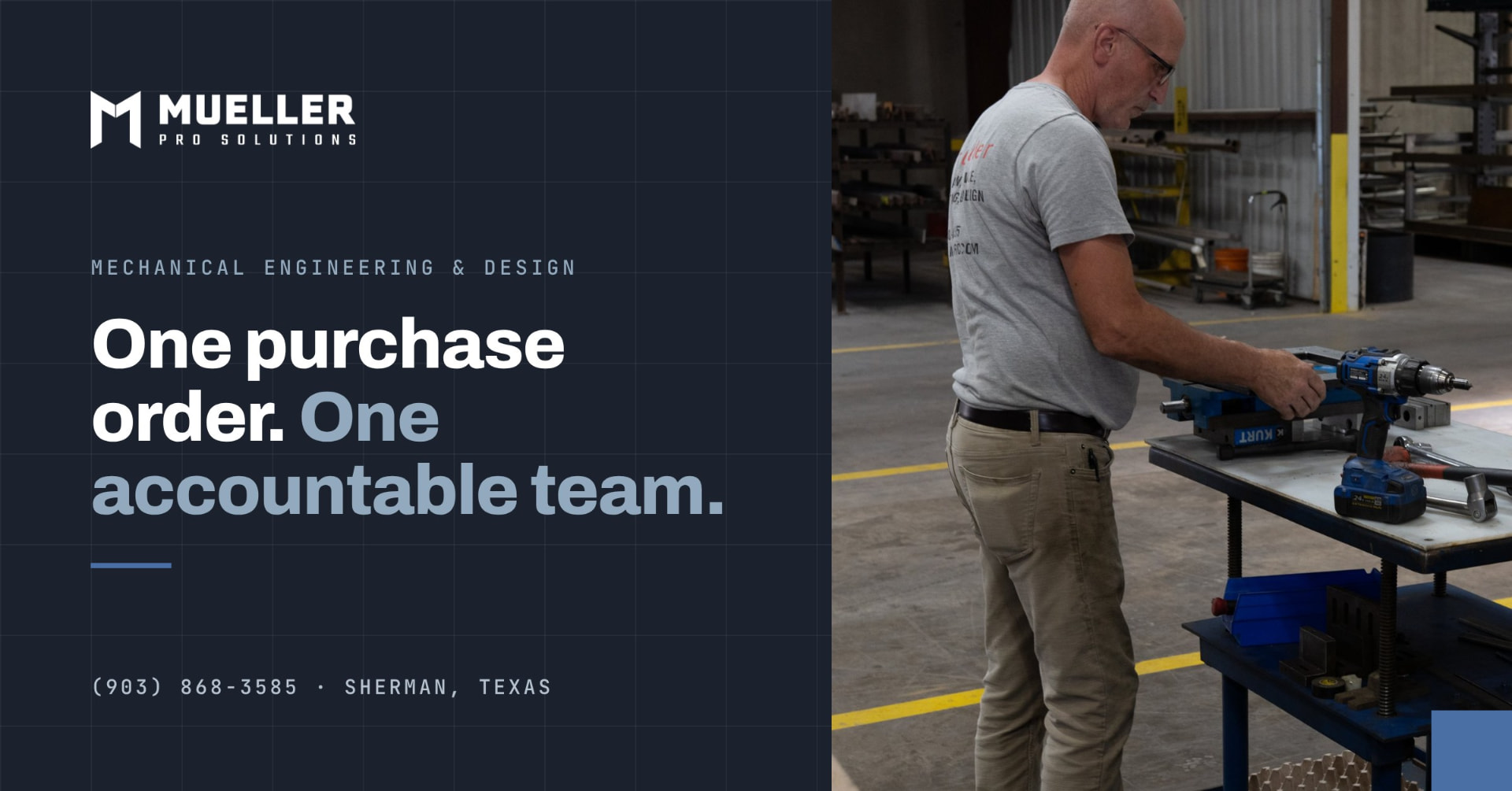
Real-world insight: At Mueller Pro Solutions, drawings are checked against how parts will be cut, welded and installed before they’re released to the shop. Engineering, fabrication and installation stay under “one purchase order and one accountable team.”
Try this: On your next project, count how many companies touch it from drawing to startup. Each one is a handoff you could cut.
How Does the Engineering and Fabrication Process Work?
Every company’s process looks a little different. Here’s how it works at Mueller Pro Solutions in Sherman, TX:
Walk the process. Engineers measure your existing equipment and document how it runs today.
Design and review. Concepts and drawings go to you for review “before anything is cut.”
Build in-house. The approved design moves to Mueller’s own machine and fabrication shop.
Install and start up. Mueller’s millwright and field crews set the equipment, tie it in and restart with staff on the floor.
Design work can also be planned around equipment that’s still running and scheduled to fit your production calendar.
Tip: Ask any engineering fabrication company when you’ll get to review drawings. You want sign-off before metal gets cut, not after.
What Kinds of Projects Need Industrial Engineering and Fabrication?
Industrial engineering and fabrication is a good fit any time an off-the-shelf part or machine won’t do the job. Common examples include:
Performance and throughput upgrades on an existing line
Safety and ergonomic improvements, like guarding and better access
Replacement parts for equipment that’s no longer supported
Custom material-handling equipment, such as conveyors, hoppers and chutes
Skids, platforms and structural frames
Mueller’s own project photos show this kind of work, especially in food processing: custom stainless augers, hoppers and conveyors, a washdown-rated sanitary mesh conveyor, a spiral freezer infeed system, process tanks and sanitary stainless piping.
What If the Original Drawings Are Gone?
This is one of the most common problems in older plants. The equipment still runs, but nobody has the prints.
An engineering fabrication company can measure the equipment on site and rebuild the geometry from those measurements. Mueller does this regularly to reverse engineer legacy equipment and obsolete parts.
Try this: Once a part is reverse engineered, ask for a copy of the drawings for your records. It’ll save time if you ever need another one.
How Much Do Industrial Engineering and Fabrication Services Cost?
There’s no standard price, because every project is custom. A single replacement bracket and a full conveyor system are very different jobs. The biggest cost drivers are:
Design complexity and how much engineering time is needed
Materials, such as carbon steel, aluminum, stainless or sanitary stainless
Quantity, from a one-off prototype to repeat production
Tolerances and finish requirements
Installation scope, including rigging, tie-ins and shutdown timing
Schedule, especially rush or after-hours work
One way combined engineering and fabrication can help control cost is by catching problems on paper instead of on the shop floor. A design-for-manufacture review is much cheaper than rebuilding a part that doesn’t fit.
Mueller Pro Solutions doesn’t publish standard pricing, but it offers free consultations for most projects, and an engineer responds within one business day with a path to a quote.
Tip: Send photos, measurements or an old print with your quote request. The more detail you share, the more accurate your quote will be.
How Do I Choose an Engineering and Fabrication Company for Industrial Projects?
Use this checklist to compare companies side by side:
In-house engineering: Do they have their own designers, or do they outsource design?
In-house shop: Which processes happen in their building, and which get sent out?
Drawing review: Will you approve drawings before production?
Reverse engineering: Can they work from a worn part or field measurements?
Industry experience: Do they know your environment, such as sanitary washdown or oil and gas?
Certifications: Is structural welding certified, and who inspects it?
Installation and support: Can they install what they build and support it later?
Responsiveness: How quickly do they reply to quote requests?
For more questions to ask, see our guide: 10 Questions to Ask a Manufacturing Company Before You Hire Them.
Who Provides Engineering and Fabrication Services in Sherman, TX?
Mueller Pro Solutions is a family-owned company in Sherman, TX, founded in 1981 and now in its third generation. It describes itself as “a full industrial resource, not a one-machine shop,” with six capabilities under one coordinated team:
Engineering and custom design
Precision CNC machining
Custom fabrication, including waterjet cutting and certified structural welding
Millwright installation
24/7 emergency repair
Automation integration
Mueller provides industrial manufacturing services for food and beverage, oil and gas, pharmaceutical, general manufacturing, education and research, and disaster recovery customers across Texas, Oklahoma and nationwide.
The Bottom Line
Key Takeaway: An engineering fabrication company takes your project from problem to installed equipment with one accountable team. Keeping design and fabrication together means drawings that fit the shop, faster changes and fewer costly surprises.
Have a project that needs both design and build? Call Mueller Pro Solutions at (903) 868-3585 or email info@muellerprosolutions.com to set up a free consultation.
Sources
Mueller Pro Solutions, Engineering & Design: https://muellerprosolutions.com/services/engineering-design
Mueller Pro Solutions, Home: https://muellerprosolutions.com/
Mueller Pro Solutions, About: https://muellerprosolutions.com/about
Mueller Pro Solutions, Custom Fabrication: https://muellerprosolutions.com/services/custom-fabrication
Mueller Pro Solutions, Industrial Installation: https://muellerprosolutions.com/services/industrial-installation